If you’re responsible for the look of fleet vehicles across many locations, you’re responsible for your brand identity in those locations too. That holds whether you’re a brand manager, a fleet manager, a marketer, or a franchisor whose operators own their vehicles. Every truck and van shows your brand in a different city. The question is whether they all show the same one.
Try this. Pull photos of five vehicles from five different locations, wrapped at different times over the last three years. Put them on one screen, side by side. Now look for what doesn’t match. The reds. A door decal sitting lower on one van than the others. Vinyl peeling at the edges on one vehicle while the rest still look clean. The truck wrapped most recently, by whoever the nearest shop happened to be, looks the least like the rest of the fleet.
Fleet vehicle wraps lose consistency when different vendors, print shops, and installers make decisions at different points in the program. It happens to fleets that grow faster than the process behind them.
Where the Inconsistency Comes From
Four parts of the process create the problem: printing, materials, design, and installation. Project management ties them together.
Printing. Different print shops run different presses, color settings, and inks. Send the same brand red to three vendors and it comes back as three slightly different reds, each one acceptable to the shop that printed it and none of them matching the others.
Materials. One location uses 3M or Avery vinyl. Another uses a different vinyl product altogether. The difference doesn’t show at install. It shows later, when one vehicle’s graphics are cracking and the edges are lifting while the rest of your fleet vehicle wraps still hold up. By then, no one on the fleet team remembers which vendor made the swap.
Design. A layout built for a box truck doesn’t carry over to a cargo van without a design kit built for each vehicle type. Skip that step and lettering gets cut off at a door seam, a face lands across a taillight, or the artwork never gets measured for the curves of the body. Those are design mistakes, made before a single sheet of vinyl is printed. The installer applies what the approved proof shows.
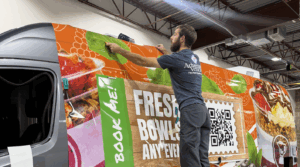
Installation. Picture three locations. One installs its own decals. Another hires a small local shop. The last uses a 3M certified installer. A trained installer cleans the surface, controls the temperature, and smooths the edges as part of the job. Graphics applied without those steps have more chances to peel and crack. Give it time and the three sets of vehicles look like three different brands.
Project management. Someone has to confirm that the right printer, the right vinyl, and the right installer are used at every location, and that the record of which art file, which material, and which crew touched each vehicle sits in one place. Without that coordination, a simple panel replacement turns into a guessing game about what is already on the truck.
The problem grows when every location, every franchise operator, and every regional team has its own printer, installer, or process. Each added handoff is another chance for your fleet vehicle wraps to change. Consistency breaks down that way: not in one bad week, but across dozens of small decisions nobody tracks in one place.
Start With What Is Already on Your Fleet
The fix isn’t a rebrand. It’s removing those variables: one print operation, one vinyl choice, one installation standard, with the program information kept together. That’s what fleet graphics management looks like when it’s running. And when you have vehicles across the United States that need to look like one brand, a problem in any of these parts of the process is more than a one vehicle problem. It’s an identity issue.
Any fleet graphics program looks right at launch. The test comes a few months later. A panel takes a hit, and someone has to reproduce the original look on one truck out of two hundred. Can they match the color from the first run? Can they get an installer there without your fleet manager burning a week on phone calls?
Your answers show whether your fleet runs on a managed program or on a series of one-off jobs that happened to use the same logo. Go back to those five photos and start there.
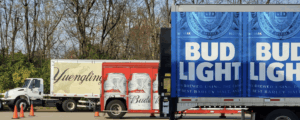
Advertising Vehicles is the exclusive nationwide fleet branding partner to Anheuser-Busch and its distributors, a partnership of more than ten years covering well over 100,000 graphics across 25+ brands. Most of those orders are print and ship, which means AV prints the graphics and ships them to the distributor, so they come from one source instead of a separate printer in every distributor’s town. For installation, AV works nationwide through a managed installer network supported by 3M-certified installers. A dedicated Cincinnati-based account manager learns your fleet, your brand standards, and your processes, and stays with you through repairs, removals, rebrands, and new locations. When a damaged panel needs replacing, you call one person instead of five shops.
Advertising Vehicles is a single-source vendor for design, print, and installation, and it also handles removal and rebrand management. One team, one standard, every location, so your vehicles show the same brand in every city they drive.